The Longest Total Solar Eclipse Until 2114 and Where You Can Catch It
A rare total solar eclipse will cross southern Spain and parts of Africa and the Middle East on August 2 2027. Discover the best viewing locations and essential safety advice.
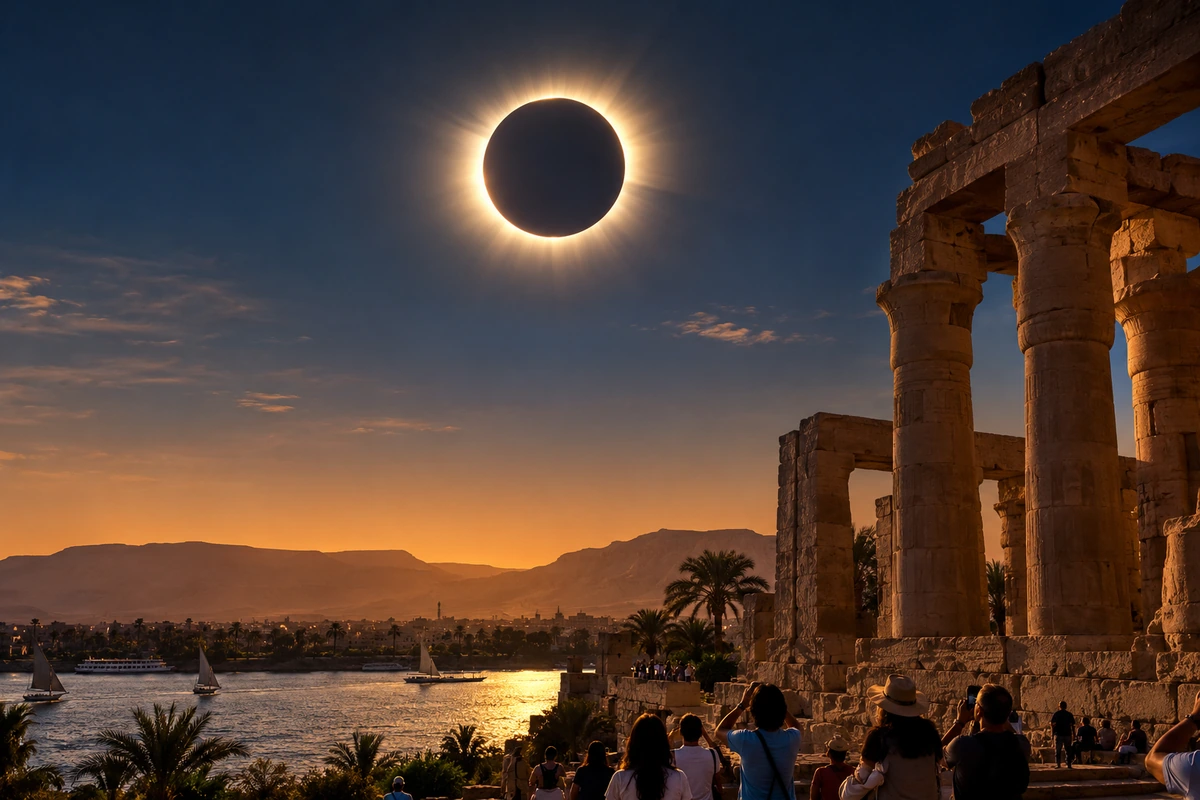
I keep imagining that first moment on an August afternoon in Egypt. Shadows turn oddly crisp and the heat stays the same while the daylight somehow changes. Then the Moon covers the Sun completely and the whole scene drops into a strange dusky dark.
People are already planning their lives around the total solar eclipse of August 2 2027.
And this one is no ordinary eclipse. Near Luxor in Egypt you get more than six minutes of total darkness. That makes it one of the longest total solar eclipses of the century and the longest one still ahead that you can watch from land before 2114.
You do not need to fly to Egypt though. Parts of Spain and Morocco sit inside the path too while the Moon’s shadow also slides over other corners of North Africa and the Middle East.
Before anything else you should know that totality lives inside a narrow moving corridor. Stand just outside it and you get a lovely partial eclipse but the sky never goes properly dark.
Working out when it all happens
The eclipse lands on Monday August 2 2027. Somewhere on Earth the first partial phase kicks off at about 07:30 UTCand totality first touches down over the Atlantic Ocean around 08:23 UTC. From there the shadow runs east across Morocco and southern Spain before moving through North Africa and the Middle East. Greatest eclipse arrives at roughly 10:07 UTC.
Local time changes the story though. A viewer in southern Spain gets the morning show while Egypt reaches totality around midday. So the numbers worth hunting down are the ones for your exact spot since no single worldwide start time will help you much.
What six minutes of darkness really means
A lot of eclipses leave you with a brief flicker of darkness and this one runs far longer.
NASA puts the maximum anywhere along the path at about 6 minutes and 23 seconds and that is a very long time to watch the Moon cover the Sun. Near Luxor you get about 6 minutes and 22 seconds which puts the city right beside the sweet spot. The Sun will also sit very high in the sky when totality begins. Imagine one of Egypt’s most historic cities sliding into darkness in the middle of the day.
Clouds are the real gamble. Picture the glowing corona around the dark lunar silhouette and then picture a thin layer of cloud drifting over it at exactly the wrong second. Duration alone will not save a trip like that.
Where the Sun vanishes completely
The path starts over the Atlantic and crosses a handful of countries. Southern Spain near the Strait of Gibraltar comes first along with northern Morocco where totality arrives in the morning. After that come Algeria and Tunisia with Libya next. Egypt follows with its long totality near Luxor and other locations. Further east the shadow crosses western Saudi Arabia then moves over Yemen and finishes across northern Somalia.
Being inside one of those countries does not guarantee totality though. Madrid only gets a partial eclipse while parts of southern Spain sit inside the corridor. Egypt works the same way with Cairo seeing a partial eclipse and Luxor getting totality. A detailed eclipse map is the first thing to open before you book a single bed.
Why Luxor keeps coming up as the best place
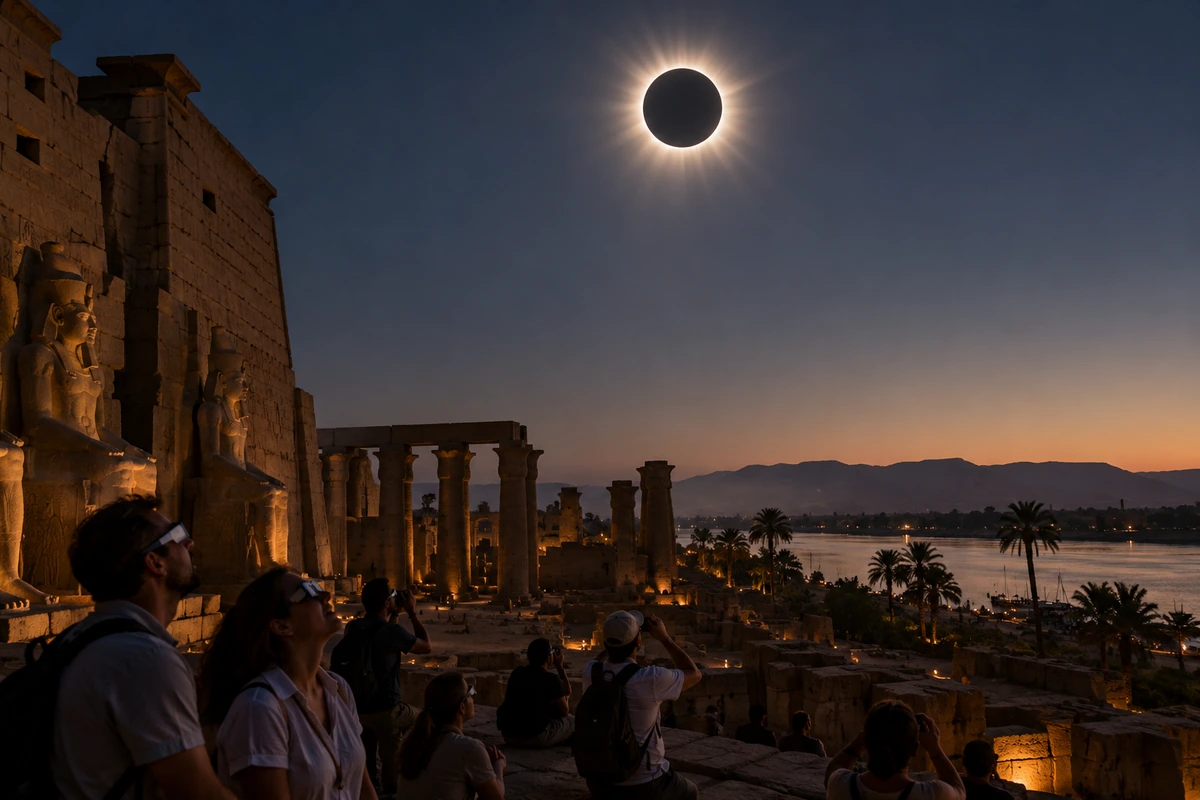
Luxor sits on the Nile surrounded by ancient temples and archaeological sites and it lies close to the center of the eclipse path. No wonder it has become the favorite for August 2027.
According to timeanddate’s astronomical calculations totality in Luxor begins at about 1:02 p.m. local time and lasts 6 minutes and 22 seconds. The maximum lands at roughly 1:05 p.m. so you get a wonderfully long window of complete solar coverage. Historical satellite cloud observations also suggest generally clear skies in the region during early August.
Now for the tradeoff. Luxor gets brutally hot in August so standing outside at midday means taking shade and water seriously along with the heat itself. Dust and local atmospheric quirks can still spoil the view too. The astronomy looks fantastic but the travel conditions deserve just as much of your attention.
A European option in southern Spain
Maybe a trip to North Africa is not in the cards. Good news because southern Spain sits inside the path on August 2.
Tarifa near the Strait of Gibraltar is a spot worth a look. Timeanddate’s calculations put totality there at around 4 minutes and 40 seconds. Málaga also lies inside the path but its totality shrinks to about 1 minute and 57 seconds. Two places in the same region can give you wildly different experiences depending on how close they sit to the center of the Moon’s shadow.
Spain also has a different kind of appeal since you can fold the eclipse into a wider European holiday with coastal stops nearby. Even so the eclipse path should decide where you go and not how pretty a city looks in a travel brochure. Morning fog or low cloud along the coast could still put a dent in the view.
Looking across the water to Morocco
Northern Morocco lets you see the eclipse without wandering far from the western Mediterranean. Tangier is one of the best known cities on the route and timeanddate expects about 4 minutes and 51 seconds of totality there. It happens in the morning and the city works well as a base for a short break around the event.
Cloud is the thing to keep an eye on. Historical data hints that Tangier gets more of it than some inland locations or parts of southern Spain. Even so a great view is still very possible and the forecast will tell you more as the date gets closer. Padding the itinerary with a spare day takes the stress out of travel while the sky at the crucial moment stays out of your hands.
What you will see from outside the path
Perhaps international travel is off the table for you. You can still catch part of the show from a much wider area.
Large parts of Europe will see a partial eclipse and so will areas of Africa and the Middle East. London and Paris sit outside the totality corridor and so do Dubai and Islamabad. In those places the Moon only covers part of the Sun. The sky may dim a little depending on how much gets covered but you will not get the deep darkness of totality or a naked eye view of the corona.
A partial eclipse is still well worth watching. You just need proper eye protection for the whole event.
How a total eclipse unfolds
The whole thing comes down to geometry since the Moon drifts between Earth and the Sun. During a total eclipse the Moon looks big enough in the sky to cover the Sun’s bright face completely and that casts a narrow shadow across Earth’s surface. Anyone standing in the middle of that shadow gets totality.
It starts quietly as a small bite disappears from the Sun. The bite grows slowly. Just before totality the last sliver of sunlight turns thin and the light around you takes on a strange quality. Then the bright surface vanishes and the Sun’s outer atmosphere appears as a glowing corona. A short while later the Moon moves on and sunlight pours back in. Outside the corridor the eclipse stays partial because the Sun never gets fully covered.
The eye safety rule you cannot afford to get wrong
Eclipse day is a big deal but one careless look at the uncovered Sun can do serious damage to your eyes.
NASA recommends eclipse glasses or handheld solar viewers that meet the ISO 12312 2 international safety standard during the partial phases. Ordinary sunglasses will not do the job however dark they look.
There is one exception. During the brief moment of complete totality and only while the Sun’s bright face is fully covered you can look with your naked eyes. The glasses must go back on before any bright part of the Sun reappears. And if you are outside the path of totality there is never a safe moment to take them off while looking at the Sun.
The same caution applies to gear which means you should never point an unfiltered camera lens or binoculars or telescope at the Sun. Special solar filters have to sit securely over the front of any optical equipment. With children in your group make sure an adult checks their glasses and watches them for the whole event.
Avoiding the mistakes that make eclipse trips expensive
A few minutes of sky can demand a surprising amount of preparation. The first question to settle is whether you want the longest possible totality or an easy destination. Luxor delivers exceptional duration along with promising historical weather. Southern Spain suits you better if a European trip is already on your list while northern Morocco makes a memorable option close to the Mediterranean.
Whichever you pick it helps to compare places to stay across several nearby locations that really sit inside the path. There is no point booking a room sold as an eclipse viewing hotel if the building stands outside the corridor of totality. Cancellation terms matter too because demand for rooms tends to jump around big astronomical events while weather and transport can still change on you. Your final viewing spot may well shift depending on local conditions.
Letting the weather guide your hotel choice
Historical cloud averages are handy for trimming a shortlist but they are only averages and the real sky on August 2 2027 will do its own thing. So put your effort into the viewing spot and treat the hotel as a place to sleep. Coastal areas can get morning fog. Egypt’s desert climate gives some locations a better record for clear skies but heat and dust bring their own headaches. It makes sense to keep your plan flexible and avoid relying on a last minute dash that crowds or road restrictions might wreck.
Taking photos without missing the show
Eclipse photography trips up plenty of experienced photographers. The brightness keeps shifting through the event so exposure settings need regular changes and any shot of the bright Sun needs a solar filter fitted over the lens. Totality then changes the light dramatically all over again.
For casual travelers the easiest plan is to let the experience sink in rather than fiddle with a camera for every second. A few carefully planned shots can be lovely. But watching the sky change with your own eyes might be even better.
Can you watch it online instead?
You can. Astronomy websites and science organizations often host live streams during major eclipses and timeanddate has a dedicated live stream page for the August 2 2027 event. That works nicely if you live outside the path or simply cannot travel. The broadcast schedule and availability are worth checking closer to the date.
Watching on a screen needs no eclipse glasses. But looking at the real Sun from where you live still needs proper protection whenever any of its bright surface remains visible.
Quick answers to the questions people keep asking
When is it? The total solar eclipse takes place on Monday August 2 2027.
Where can you see it? Totality runs along a narrow path through southern Spain and North Africa and then crosses selected regions of the Middle East.
Just how long can the darkness last? Right at the center of the path it stretches to about 6 minutes and 23 seconds according to NASA.
Does Egypt get totality? Yes. Several parts of Egypt will see it and Luxor should get about 6 minutes and 22 seconds.
What about the UK? Parts of the UK will see a partial eclipse but not totality.
Will Dubai go dark? It will not. Dubai sits outside the path of totality and gets a partial eclipse.
Do you need special glasses? You do during every partial phase. Proper solar viewing protection is a must whenever any bright part of the Sun is visible.
Why you should mark this one down now
The August 2 2027 eclipse is one of those rare events where your experience depends completely on where you stand. Wander a short distance in the wrong direction and you miss totality. Pick the right spot and the sky can turn dark in the middle of the day for more than six minutes.
Luxor may give many travelers the longest and most dramatic show while southern Spain and Morocco offer other brilliant ways to witness it. The one thing nobody can book in advance is clear weather. That is exactly why early preparation pays off. You can study the path and compare destinations right now and still leave room to adjust your final plan as August gets closer.
For a few extraordinary minutes the most familiar light in our sky will disappear behind the Moon. And if you are standing in the right place you will get to watch it happen.
Reader Reaction
Was this article useful?
1 reader likes this article.
Share This Article
Found this story useful? Share it with your network.
Comments
0 discussionsAdd your perspective, reply to other readers, and keep the conversation useful.
Conversation
Reader responses